Skip to content
📑 Paper Manuscripts
1. Origin and Introduction in India
- Paper was invented in China (~100 BCE) and spread via the Silk Route to Central Asia.
- In India, paper began to be used around the 10th–12th century CE, but became widespread by the 14th–15th century CE.
- Early Indian manuscripts were written on:
- Birch bark (North India – Kashmir).
- Palm leaves (South India – Karnataka, Kerala, Tamil Nadu, Odisha).
- Paper slowly replaced these materials because:
- It was lighter, easier to prepare, and more durable than palm leaves.
- It allowed smaller script, illustrations, and ornamentation.
2. Features of Paper Manuscripts
- Written with natural ink (carbon, indigo, iron-gall ink).
- Some manuscripts are illuminated with gold, silver, and vegetable colors.
- Often stored in wooden boxes, silk/potli wrapping, or leather covers.
- Could be bound like a book (codex) unlike palm leaves, which were tied with a string.
3. Spread in India
- Delhi Sultanate & Mughal Era (13th–18th century CE):
- Flourishing of Persian, Arabic, and Sanskrit manuscripts on paper.
- Illustrated manuscripts like Baburnama, Akbarnama, Razmnama (Persian Mahabharata) were created.
- Regional kingdoms (South India):
- Vijayanagara Empire and Nayakas produced Kannada and Telugu manuscripts.
- Many Jain, Shaiva, and Vaishnava scholars used paper after the 15th century.
4. Paper Manuscripts in Karnataka
- Gradually replaced palm leaf writing after the 15th century CE.
- Stored in Mathas (monasteries), temples, and royal courts.
- Subjects:
- Kannada literature (Vachanas, Puranas, epic retellings).
- Sanskrit works on astrology, Ayurveda, and Vedanta.
- Administrative records – royal decrees, temple grants.
- Major repositories:
- Mysore Oriental Research Institute (MORI), Mysuru.
- Karnataka State Archives, Bengaluru.
- Sringeri Matha, Shravanabelagola Jain libraries.
- Scripts found: Halegannada, Nandinagari, Grantha, Nagari, and Persian-Arabic (during Adil Shahis & Mysore Sultans).
5. Preservation Challenges
- Paper decays faster than palm leaf if exposed to humidity, insects, and sunlight.
- Many manuscripts are brittle and faded today.
- Modern conservation uses:
- Deacidification chemicals.
- Digitization projects (National Mission for Manuscripts, Govt. of India).
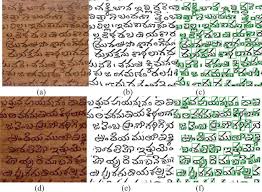
- OCR & AI projects (like yours 👍) to transcribe into modern text.
6. Significance of Paper Manuscripts
- Bridge between ancient palm leaf tradition and modern printing culture.
- Helped in faster knowledge dissemination during medieval India.
- Rich resource for studying Kannada history, literature, mathematics, and medicine.
- Show evolution of script styles and calligraphy.
7. Famous Examples from Karnataka
- Sanskrit manuscripts in Nandinagari script preserved at MORI.
- Jain Agamas written on paper at Shravanabelagola.
- Royal Vijayanagara letters & Kannada chronicles (e.g., Keladinripa Vijayam).
- Persian manuscripts from Bijapur and Srirangapatna (Tipu Sultan’s period).